Foreclosures Gone Wild 1
Foreclosures Gone Wild 2
Foreclosures Gone Wild 3


The slide in U.S. home prices may have another three years to go as sellers add as many as 12 million more properties to the market…
“Whether it’s the sidelined, shadow or current inventory, the issue is there’s more supply than demand,” said Oliver Chang, a U.S. housing strategist with Morgan Stanley in San Francisco. “Once you reach a bottom, it will take three or four years for prices to begin to rise 1 or 2 percent a year.”…
Fannie Mae Forecast
Fannie Mae, the largest U.S. mortgage finance company, today lowered its forecast for home sales this year, projecting a 7 percent decline from 2009. A drop in demand after the April 30 tax credit expiration “suggests weakening home prices” in the third quarter, according to Fannie Mae…
8 Million
Douglas Duncan, chief economist for Washington-based Fannie Mae, said in a Bloomberg Radio interview last week that 7 million U.S. homes are vacant or in the foreclosure process. Morgan Stanley’s Chang said the number of bank-owned and foreclosure-bound homes that have yet to hit the market is closer to 8 million…
In addition to the as many as 8 million properties vacant or in foreclosure, owners of another 3.8 million homes -- 5 percent of U.S. households -- said they are “very likely” to put their properties on the market within six months if there is improvement, according to a survey</a> by Seattle-based Zillow.
“This has the potential to create a sawtooth pattern along the bottom,” Stan Humphries, Zillow’s chief economist, said in a telephone interview. “Homes begin to sell and a few sidelined sellers rush into the marketplace and flood the marketplace.” …
The Obama administration’s effort to help mortgage holders, HAMP, is another source of future inventory as owners with new loan terms re- default, Ritholtz said. About half of the modifications done in 2009 were behind in payments by the first quarter of 2010, according to the Treasury Department…
Read the full article by clicking the link below…(if you dare)
U.S. Home Prices Face 3-Year Drop as Inventory Surge Looms - Bloomberg
A local attorney who counsels many of our clients, Richard Zaretsky, has just posted this excellent article on his blog. It answers the very common, but perplexing question posed above.
Do We All Have A Common Goal? Do all short sellers cooperate with the short sale process? The answer is a resounding NO. The short seller is typically living in the house "for free" and is not all that interested in moving out and paying rent. Therefore, short sellers are notoriously delay oriented. Banks believe this to be a fact.
I Want To Stay! Loan Modification borrowers are in a somewhat different boat. They don't have any plan to move out of the house as they want to modify the loan to something more affordable.
They Want WHAT!?!@? Short Sellers and Loan Modification borrowers have something in common - they have to accept the lender's terms of the short sale or loan modification or face loss of the home through foreclosure. The alternative of the loss of the house in foreclosure is usually not an desirable option. The lender can never be sure that (a) the buyer in a short sale is not going to walk away from the sale at the last minute, (b) the seller will accept the demands the lender conditions the short sale approval upon, or (c) the borrower will accept the loan modification terms offered by the lender (if any are offered at all).
Hurry Up and Wait? So knowing or believing all the above, if you were the lender and you knew that from start to finish the mortgage foreclosure process was going to take 300 to 700 days and the short sale or modification may or may not end up successful, would you wait 3 or 5 months for a short sale contract or for the borrower to submit complete loan modification information - BEFORE you started the clock on the foreclosure process? OF COURSE NOT! Therefore, even if you have a good faith intention to proceed with a short sale or loan modification, the lender will NOT stop a pending suit or delay filing an otherwise ripe suit for foreclosure. The result is one hand of the lender pursues solutions with the borrower and the other hand of the lender pursues solutions against the borrower - all at the same time.
Remind Me To Stop Before I Drive Off the Cliff! Even the HAFA and HAMP programs have guidelines for participating lenders that state that the lender will not have to stop the foreclosure process - but only that if a borrower is accepted into the processing of under HAFA or HAMP, the lender will not actually have the foreclosure sale! But they can go all the way to getting a foreclosure sale date set!
So if you are trying a short sale or modification, don't be surprised when the Sheriff rings your doorbell at 6 a.m. with a subpoena and summons and complaint for foreclosure even though the nice people at the bank are helping you in your "solution". If you are 90 days or more late (typically), you should expect that visit and introduction to your foreclosure complaint very very soon. And once you get served BE SURE TO IMMEDIATELY CONTACT YOUR ATTORNEY TO DISCUSS THE FORECLOSURE AND WHAT SHOULD BE DONE ABOUT IT.
Read Richards entire article here: WHY IS THE BANK FORECLOSING IF I AM DOING A SHORT SALE (OR LOAN MODIFICATION)?
Below are a few of today’s housing industry headlines:
You can read the article here: Freddie Mac estimates home sales to fall another 23% in 3Q « HousingWire
You can search for sexual predators by zip code via the link below:
FDLE Florida Sexual Offenders and Predators - Offender Search

But if you read this blog…YOU shouldn’t have been surprised at all. I have been counseling my sellers for many months now…you want to be the NEXT home to sell!
Here are some snippets from some of today's press releases:
1) Sales of previously occupied homes plunged last month to the lowest level in 15 years, despite the lowest mortgage rates in decades and bargain prices in many areas.
July's sales fell by more than 27 percent to a seasonally adjusted annual rate of 3.83 million, the National Association of Realtors said Tuesday. It was the largest monthly drop on records dating back to 1968, and sharp declines were recorded in all regions of the country.
2) With home sales plunging to their lowest level in 15 years, economists warn that a double-dip in housing prices is just around the corner, threatening to further slow the overall recovery.
Existing home sales sank 27.2% in July, twice as much as analysts expected, to a seasonally adjusted annual rate of 3.83 million units. Much of that drop is attributed to the end of the $8,000 homebuyer tax credit. Sales of single-family homes, which account for a bulk of the transactions, are at the lowest level since May 1995.
Inventory has also continued to climb, rising 2.5% to 3.98 million existing homes for sale. That represents a 12.5-month supply at the current sales pace, the highest since October 1982 when it stood at 13.8 months. A six-month of supply is considered normal.

Chart of existing home sales…watch out for that falling knife!
"....Purchases of existing homes plunged 27.2 percent to a 3.83 million...Estimates in the Bloomberg survey of 74 economists ranged from 3.96 million to 5.3 million..." Good job experts
Still want to listen to the ‘experts’?
If you are even thinking that you may want/need to sell anytime in the near and not-so-near future…please give me a call so we can have a lively discussion regarding my recommendations. My direct line is 561-602-1258
Thanks for reading,
Steve

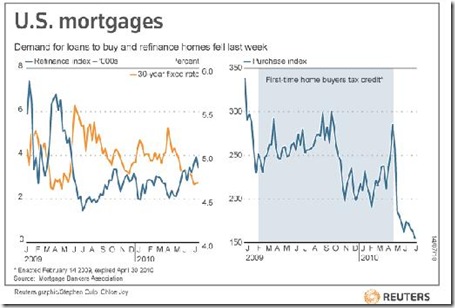

The experts expected home sales to drop once the homebuyer tax credit lapsed at the end of April, but the depth of the decrease was shocking (only to the “experts”).
According to the National Association of Realtors (NAR), pending home sales fell a whopping 30% in May. Their index, which measures signed sales contracts but not closed sales, plunged to 77.6 from 110.9 in April. It's even off 15.9% from a year ago when the nation was barely emerging from the recession.
The pending home sales report is a disaster," said Mike Larson, a real estate analyst for Weiss Research. "Sales fell off a cliff after the tax credit expired. It's the biggest monthly decline ever and the index is at its lowest level since NAR began tracking it in 2001."
(As expected)…Lawrence Yun, NAR's chief economist, downplayed the damage a bit. According to him, customers rushed into deals to claim the credit, borrowing from May sales. Once the economic recovery comes into full swing, housing markets will heat up. "If jobs come back as expected, the pace of home sales should pick up later this year," said Yun, "and reach a sustainable level of activity given very favorable affordability conditions."
The question is when -- or if -- the job market will ever bounce back.
"We're not creating jobs," said Larson. "The housing problems now are being driven by broad economic problems."
Wednesday, June 30th, 2010, 11:34 pm
Yesterday, the House pushed through a three month closing extension of the homebuyer tax credit.
Tonight, the Senate unanimously approved the bill — leaving the President to ratify the provision by signing it into law, as early as tomorrow morning.
"I thank my colleagues for joining me to pass this important extension and giving homebuyers in Nevada and around the country the opportunity to purchase their first home," said Sen Harry Reid (D-NV), in a statement following the bill's passage.
"In addition to helping thousands of families experience the American dream, this successful and popular program provides a much needed boost to Nevada's housing market and economy."
The deadline for the tax credit was midnight tonight but only if the mortgage went through, so with Obama's signature, it would have been possible that no contracts currently under offer — but unable to close — would fall through the cracks with the extended deadline.
The Senate approved provision will give buyers until Sept. 30 to complete their purchases and qualify for tax credits of up to $8,000.
If the President signs the bill into law tomorrow, it is unclear if the provision will apply retroactively to deals that close on Thursday, July 1.
C-Span is a wonderful thing. Just listen or watch - The House Oversight and Government Reform Committee hearings yesterday brought in some interesting statements from CEO's and Presidents of Bank of America, JP Morgan/Chase and others.
As I reported in my article WALK AWAY FROM THE PROPERTY - STRATEGIC MORTGAGE DEFAULTS GROW TO 26%, that figure is now updated by the University of Chicago and Northwestern University researchers for the previous figures - a year later the strategic default rate is up another 10%!
Why is this happening? Industry leaders blame the government programs. The HAMP program has 800 specific requirements for the borrower - 800 !!! No wonder it takes 4 to 6 months for a person to go from trial modification to permanent modification. Numbers for successful conversions under HAMP is running about 10% of trial modifications.
What makes a borrower ineligible for HAMP or other (proprietary) modification programs of the lender? Testimony today said that government regulations of easy credit made the banks make loans to people that could not afford the mortgages they got - and this is now the end result - these borrowers still do not qualify even for a modification! A big reason for rejection - trial mod recipients don't pay the reduced payments or don't provide necessary documents.
Modification requirements always now require real, as opposed to "stated", income revelations. Many borrowers don't give the required information on their "real" income to qualify for the modification. Why? Testimony suggested being afraid of the IRS, or being intimidated because of perhaps false documents in the beginning, are other reasons.
I loved the comments from Rep Elijah Cummings - his staff sent documents on behalf of constituents to a lender and those documents got "lost" - several times! And he had proof that payments were made to the lender and the lender failed to acknowledge the payment even when the Congressman's staff showed the lender the cancelled check.
When asked what is the solution - lenders said there needs to be a "dignified transition". What is THAT? A "dignified transition" is making homeowners into renters! " Not all homeowners should be owning a home". Well, I cannot disagree with that, but it just does not sit well. So they suggest that short sales be the "dignified solution".
Maybe Washington is listening and even feeling the pain. Keep watching and tell your Washington representatives what you think needs to be done.
Copyright 2010 Richard P. Zaretsky, Esq.
Be sure to contact your own attorney for your state laws, and always consult your own attorney on any legal decision you need to make. This article is for information purposes and is not specific advice to any one reader


 Posts
All Comments
Posts
All Comments